Showing posts with label books. Show all posts

Tuesday, May 21, 2013

Book Review: Twinkie Deconstructed

Twinkie, Deconstructed: My Journey to Discover How the Ingredients Found in Processed Foods Are Grown, Mined (Yes, Mined), and Manipulated Into What America EatsTwinkie, Deconstructed: My Journey to Discover How the Ingredients Found in Processed Foods Are Grown, Mined (Yes, Mined), and Manipulated Into What America Eats by Steve Ettlinger
My rating: 3 of 5 stars

“Twinkie, Deconstructed” is a book with one, horrifying central theme: all the ingredients in a Twinkie have a single source – petroleum. The book became painfully repetitive as it described how once again, the ingredient was made from fossil fuels. Over and over again this book describes processes of heat and extraction that result in the production of the chemically-laden “food” that makes a Twinkie.

I had expected the ingredients in Twinkies to be a chemical horror, but what really brings this book home is how Ettlinger breaks down the ingredients and shows the reader how some of these ingredients are used in the home. Ever use baking powder or bleached all-purpose flour? Then you too have a cupboard full of highly processed foods. The process for imitation vanilla is amazing.

Though I have not had a Twinkie in thirty years, this book made me think about all of the other foods that I eat that have similar ingredient lists. These petroleum-based ingredients can be found in practically any processed food you might encounter – everything from pasta sauces to lunch meats.

I gave this book thee stars because I did find the format repetitive, though that is not entirely the fault of the author. And the repetition did serve to drive home what is really in our food. I also had just finished the book “Salt, Sugar, Fat” which does a better job of writing about a similar thing. I felt that Ettlinger did not press his sources enough regarding the health and safety of the ingredients he was researching. That being said, “Twinkie, Deconstructed” was a real eye-opener. If you are interested in the chemistry of food, or food origins, this will be a great read for you.


View all my reviews

Friday, April 19, 2013

Fungus Among Us! Part 1– Medicinal Mushrooms

This is a second post based on classes I took at the Organic Growers School (OGS) Conference in March of this year. Two of the best classes I attended this year were Medicinal Mushrooms  and Shroomin’ Off The Grid, both taught by mushroom evangelist, Tradd Cotter. Cotter owns and operates Mushroom Mountain in South Carolina, and has made a name for himself with his work on mycoremediation and spore cultivation. If you have questions about mushrooms, this is the guy to ask!

So first I’d like to address medicinal mushrooms. Cotter’s lecture on this subject was fast and furious. He probably condensed a 3 hour lecture into an hour. There was more information than I could even absorb.

According to Cotter, many mushrooms contain antibiotic, anti-pathogenic, and some even seem to protect against cancers! For instance*:

Chanterelles – contain a cancer-fighting enzyme, are high in beta carotene and vitamin D if grown exposed to light for a couple of hours a day.


Cordyceps mushrooms – are an immune system stimulant that is frequently given to people undergoing surgery.These mushrooms are also carnivorous! They attack and eat insect pupae and the mushrooms frequently sprout out of the back of the pupae’s head. Gnarly! Some of these mushrooms can be used to kill fire ants, squash bugs, aphids, etc. Think of the gardener’s who could use this fungus! Cordyceps Ophioglossoides has been shown to stimulate adult brain cells to grow. It is being researched on its ability to reverse brain diseases like Alzheimer's.

Lion’s Mane (Hericium Erinaceus) – cook this mushroom to release a nerve tonic


Psilocybin (Magic Mushrooms) – are currently being studied at Johns Hopkins as a treatment for addiction and PTSD. Preliminary studies has shown great promise with just one dose!


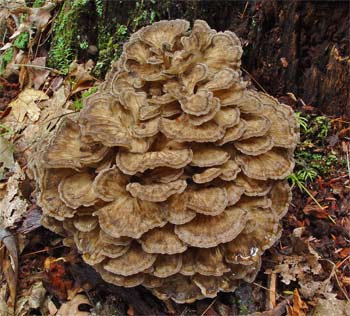
Maitake – Makes a great tea and has anti-cancer properties.


Chicken of the Woods – kills e-coli bacteria and is a great treatment for fungal infections.


Wood Ear – (commonly used in hot and sour soups) These mushrooms dehydrate down to a fraction of their original size, but rehydrate almost completely. These mushrooms store well and are high in anti-coagulants.


Enoki (Velvet Foot) – is very high in anti-cancer properties.


Almond Portobello – tastes like toasted almonds when cooked and is high in anti-cancer properties.


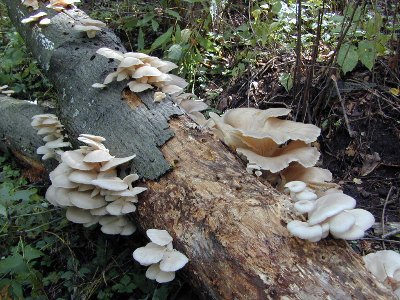
Pleurotus (Oyster) – has twice the protein of eggs, is high in psyllium, is anti-viral and anti-parasite.


Corn Smut – a corn fungal pathogen that tends to grow on Silver Queen and other heirloom varietals. This fungus tastes like a corny guacamole and can help with uterine contraction.


Turkey Tail – dried and powdered has been studied in its use to fight breast cancer. Seems to work as a preventative as well.


Reishi (Ling Chi) – is known as the Mushroom of Immortality. If this mushroom is grown in light, it is more medicinal. This amazing mushroom is adaptogenic, immune enhancing/modulating, and has ganoderic acid (for diabetics). Cotter made us some reishi mushroom tea to try and it had a pleasant earthy/chocolate flavor. This medicinal can be dried and powered or extracted.

Cotter recommends reading The Fungal Pharmacy by Robert Rogers for more information on medicinal mushrooms. If you are interested in growing your own medicinal mushrooms, check out my next posting on Shroomin’  Off The Grid!

* This information is not intended as medical advice. Do not ingest any mushrooms without assurance from a mycologist that they are safe to eat.


Monday, April 8, 2013

Composting: Not Just For Kitchen Scraps!

The Complete Compost Gardening GuideThe Complete Compost Gardening Guide by Barbara Pleasant
My rating: 5 of 5 stars

This is the only book on composting you will ever need. It discusses many different composting methods, style, and tools, and it ends on uses, cover crops, and green mulching. It uses the real, personal experiences of the authors, fantastic step-by-step photos and diagrams, and some great recipes and info graphics.

I got a lot of new ideas and plans from this book, and I can't wait to get started on my new composting projects. I checked this book out of the library, but it is such a fantastic resource, that I will soon be purchasing my own copy.

View all my reviews

Tuesday, February 28, 2012

Worms Will Be Eating My Garbage

I checked "Worms Eat My Garbage" by Mary Appelhof out of the library so that I could prepare for starting my own worm farm. I am expanding my gardens this year, and with Florida's sandy soil, I need to find ways to supplement it. I've read that vermicomposting is a great way to produce nutrition for a garden, and that Mary Appelhof is the #1 expert on the subject.

This book could definitely use an update. It was written in 1982, before worm farms were commercially produced, before the internet, and at the start of interest in the US in recycling. I would love to see the resources section updated for the present times, and I would like to know Ms. Appelhof's opinions on the new commercially produced worm bins.

That being said, I still learned a lot from this little book. Appelhof's information on worm ecology, biology, and care is detailed and easy to understand. Her section on the other critters that are likely to live in your worm bin was also very informative.

Thanks to "Worms Eat My Garbage" I feel fully prepared for the arrival of my Worm Factory 360 and my 1800 Red Wigglers.